
EMPATHY ASSESSMENT REPORT

Empathy is the ultimate form of customer insight
- Don Peppers -Conceptualized & Designed by Centre of Strategic Mindset
Introduction - What is Empathy?
The definition of empathy varies. Merriam-Webster dictionary defines Empathy as ‘the action of understanding, being aware of; being sensitive to, and vicariously experiencing others’ feelings, thoughts and emotions, whether emanating from their past or present experiences’. To make it more concise, empathy implies an accurate understanding of someone else’s perspectives and experiences. To be empathic would not only mean seeing others’ perspectives (both intellectual and emotional) but also gaining an insight into the legitimacy of that perspective.
“It is important to note that, in most cases, an intellectual understanding is insufficient – to be empathic one must understand the emotional experience of that individual”.
Empathy is not a soft nurturing value, but a hard commercial tool that every business needs as part of their DNA to stay relevant as well as significant.
In Harvard Business Review (Parmar, 2015b), it is also stated that there is an obvious correlation between empathy and commercial success. Besides, businesses are far more profitable and productive when they act ethically, and treat their staff with respect, and communicate better with the customers. The fact that supports this statement is that the top 10 companies in the Global Empathy Index 2015, increased in value more than twice as much as the bottom 10, and generated 50% more earnings. The average earnings of the top 10 companies went up by 6% in 2015, while the average earnings of the bottom 10 companies, further dropped 9% (Dishman, 2015).
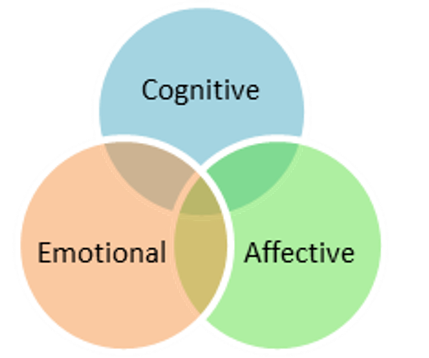
The past decade has seen a growing movement towards a view that postulates empathy as a multidimensional construct. Therefore, it is worthwhile for us to understand the construct and apply it in our lives.
Empathy Construct
| • |
Cognitive Empathy- Cognitive Empathy-the ability to understand another person’s perspective; |
| • |
Emotional Empathy - the ability to feel what someone else feels; |
| • |
Affective Empathy - the ability to sense what another person needs from you |
Background Research
Our tryst with empathy is two decades old. In our research on empathy, we have closely observed more than 5000 people and interviewed 500 plus leaders across industries and levels, to arrive at 10 critical insights as under:-
1. Empathy is learnable through reflections and structured discipline.
2. There are stages that can be acquired, honed and mastered.
3. Each preceding stage is a precursor to understanding and learning the next stage.
4. In nutshell, it is a simple process of activating ‘Stop-Start-Continue’ discipline when it comes to understanding and manifesting empathetic behaviours.
5. Empathy is rooted in observation as well as non-judgement, almost simultaneously.
6. Empathy is about striking a balance between the inner world as well as the external or someone else’s world, through a series of interactions between stimuli and responses.
7. Empathy is a muscle that develops with deliberate and disciplined exercises.
8. Empathy is not mere sympathy; it is rooted in concrete actions triggered by a ‘moving experience’.
9. Empathy is critical to innovation, relevance and significance.
10. Empathy is severely under assault due to modern day distractions, temptations and an excessive focus on ‘I - me - my’ syndrome.
Key Questions that Influenced COSM’s Research on Empathy
1. What is true empathy?
2. How does it differentiate itself from sympathy?
3. What behaviours exhibit themselves on the spectrum of Apathy, Sympathy and Empathy?
4. Why empathy can lead us to an ‘Epiphany’ (the moment of truth)?
5. Why empathy is such a misconstrued or misunderstood phenomena?
6. How come empathy is such a hard thing to develop?
7. Why empathy is often considered to be a misnomer when it comes to driving hard and aspirational results?
8. Why do we need to practice or lead with empathy?
9. How to develop empathy in a structured and conscious manner?
10. How to cultivate an Empathetic Mindset?
Empathy – An Instrument for Epiphany

How do we balance our personal needs with others’ requirements forms the basis of EMPATHY EQUATION between two stakeholders or among multiple ones. And it is never a perfect or a stationary balance. It is an oscillating or shifting balance. As long as we are able to appreciate this reality, and are willing to make adjustments, we can succeed in keeping this balance intact, and the empathy equation in a desirable equilibrium.
Empathy Index – Fundamental Dimensions
Empathy Index is based on five fundamental dimensions. Each of these dimensions displays a distinctive and predictable pattern of relationships with definitive measures that provide a considerable evidence for a multidimensional approach to empathy.

Ability to relate to the emotions that people around us carry, and their state of mind, which drives their actions and behaviours. People are a product of their experiences that influence their beliefs, logics and frame of references. If we can pause to appreciate where others are coming from, we can adjust our approach, responses and hopefully influence our outcomes.

Ability to feel something deeply and resonate with others' emotions and feelings, without judgement. The basic approach here is 'Appreciate First - Critique Later'. The core discipline to adhere here is, to gain entry into others' world with a sense of wonderment and curiosity; and not with prejudices. It is our capacity to resonate with another person in a manner, which is positive, affirming and empowering so that the rapport is established.

Ability to come out and reframe our understanding that existed prior to experiencing others' world. The propensity here is to challenge and realign our assumptions as well as belief systems, in the light of contradicting information or thought-patterns manifested by others. This allows us to understand others' point of view, find opportunities to eliminate our assumptions and make new frames of references. Assumptions are the least form of knowledge, so reframing our understanding is critical.

Ability to adapt and calibrate our stance, position or approach with new or better understanding of the stakeholders and situations, to build rapport, create alignment and strike breakthroughs. This calls for agility, flexibility and capacity to reconsider or re-examine your actions as well as responses, based on others' thought process. It is our calibre to frame new belief systems or alter existing thoughts to navigate the relationship challenges and prime ourself to respond to other person’s needs.

In the end, it is all about reimagining possibilities, visualizing prospects and neutralizing constraints, through better understanding, relatability, resonance, reframing and reorienting our approach. This is the level of empathy that is required for mutual win-win, co-creation, innovation and change. It is the prowess to skilfully design behaviours that are in resonance with own value system, yet respectful of others' belief systems, thus leading to affable responses.
Using the Report
The Empathy Index Report is designed to give you an insight into your Empathy Quotient along five empathy dimensions. Each dimension was subject to self-evaluation on eight survey items that capture the most conspicuous behaviours and belief systems. Your responses have been indexed on a five point ‘Frequency Scale’ as under:-
| 1. |
Never |
| 2. |
Rarely |
| 3. |
Seldom |
| 4. |
Often |
| 5. |
Always |
The purpose of the scale is not to test your awareness; whether you know or do not know a particular dimension, but to give you a chance to self-evaluate the frequency with which you bring these behaviours into a conscious realm of application.
Your scores will broadly determine your ability to exercise empathy and gain a critical insight into others’ world (customers and stakeholders) and the barriers that you will do well to overcome, through structured reflections and translating your insights into behaviours on ground.
Having a better understanding of our own empathetic quotient, enables us to reframe and realign our thought processes to meet the empathy needs of the users.
Hope you enjoy your report as much as we enjoyed creating it.
Overall Empathy index – Interpretation of Scores
Please read following guidelines to make sense of your scores and devise your measures to enhance your empathy index.
You have got a score of 63/ 160 as a combined total of EMPATHIC INDEX.
Let us understand what this score means for
180-200 (90% to 100%) : Level 5 = You understand, embody, and exemplify empathy, exceptionally well. You have the wherewithal to ‘role-model’ empathy in your context and be a champion. Keep up the good work but be wary of the empathy fatigue and its potential overuse, by actively asking this question, “Is there something getting overlooked or ignored in the garb of empathy”?
140-179 (70% to 89%) : Level 4 = You often understand and demonstrate empathic concern at a cognitive as well as emotional level but will do well to enhance your effectiveness by identifying opportunities for real application.
100-139 (50% to 69%) : Level 3 = You show selective evidence of understanding and practising empathy, but your record is sporadic, and consistency is missing. Having understood the power of empathy, you will do well to increase your attempts of applying empathy and creating a positive lasting residue.
60-99 (30% to 49%) : Level 2 = There is little evidence to suggest that your tryst with empathy has begun, yet. It may be a good idea to explore, if there are any contradictions in your mind as regards the understanding as well as the potential of empathy, as an instrument of transformation and impact.
01-59 (0% to 30%) : Level 1 = Your scores suggest a huge gap in understanding empathy and a missing opportunity in appreciating its impact on the people that you lead or may lead in future, in a given context. The sooner you begin this journey, the better you will get at the game of leading.

Empathy is
Seeing with the eyes of others
Listening with the ears of others
Feeling with the heart of others
It is about Others and not about You